Common description
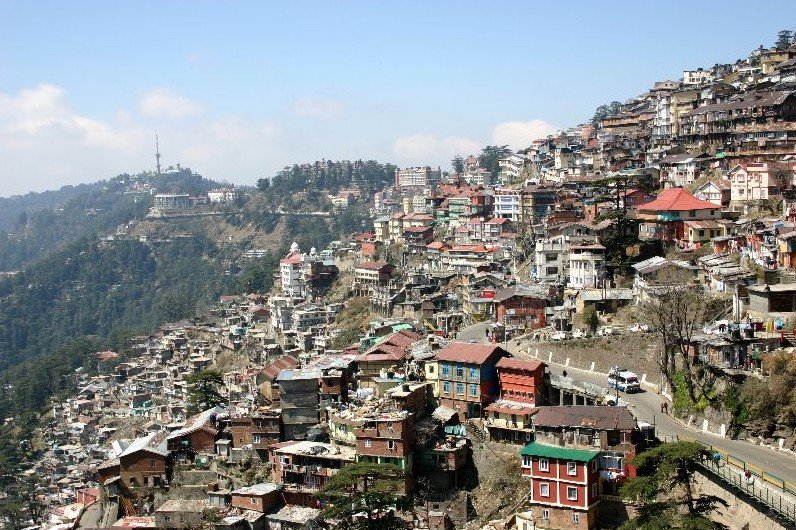
Shimla is the administrative center of Himachal Pradesh. The population is 163,000 (2001). Science Center. Mountain Climatic Resort. During the British rule Shimla was the "summer" capital of India. The government has been running here from blazing Delhi all summer long. Nowadays Shimla is a mountain resort in Northern India, in the foothills of the Himalayas, at an altitude of about 2000 m, where millions of Hindus come to rest every year from the heat. They ski, go rafting and fishing, admire mountain scenery and bathe in waterfalls.
The main celebrity in this city is Lake Revalsar, located in the mountains 24 kilometers southeast of Mandi. The lake is a pilgrimage site for Hindus, Buddhists and Sikhs. It is especially revered by Tibetan Buddhists and several Tibet monasteries built on its shores. The reason for this importance of the lake is based on the legend that the great teacher Padmasambhava (Tibetan - Guru Rinpoche), from here began his journey to Tibet in the eighth century AD. His advent on the roof of the world has influenced the entire history of Tibet. Due to his mythic exploits, the spirits and deities that impeded the development of Buddhism in Tibet were subjugated, and Buddhism subsequently became the dominant religion. Numerous legends are associated with the name Padmasambhava (Sanskrit. Lotus-born), he is the author of numerous teachings and texts. Many of them were left in secret places, discovered hundreds of years later, and led to the establishment of new lines of teaching in the tradition of Tibetan Buddhism. It is thought that Padmasambhava himself was the Buddha who emerged from the lotus flower and appeared to give a higher knowledge of Buddhism, called Vajrayana or the Diamond Chariot. That is why Lake Revalsar attracts so many Buddhist pilgrims.
The lake is surrounded on all sides by mountains, on top of one of which is a cave, where he spent some time in Padmasambhava meditation. The approaches to the cave are adorned with countless prayer flags and mantras embossed on the rocks, a large statue of the teacher himself is installed inside the cave and electricity is supplied. Tibetan monks look after the cave. It is the lake according to legend that owes its appearance to the wonder created by Padmasambhava. The case was this: the local ruler, being offended by something in Padmasambhava, imprisoned him and sentenced him to a higher degree of punishment - burning on a fire. During Padmasambhava's execution, playing turned fire into water, water came and went, resulting in the formation of Revalsar Lake.
The Tso Pema Festival is dedicated to the precious Master. The significance of this festival grows especially in the year of the monkey every twelve years, when the Dalai Lama himself comes here to do a special puja (a kind of service), to go through the bark, a ritual walk around the lake, and to climb a mountain cave where, according to legend, Padmasambhava was alone before traveling to Tibet. There are also Hindu temples built around the lake.
The main celebrity in this city is Lake Revalsar, located in the mountains 24 kilometers southeast of Mandi. The lake is a pilgrimage site for Hindus, Buddhists and Sikhs. It is especially revered by Tibetan Buddhists and several Tibet monasteries built on its shores. The reason for this importance of the lake is based on the legend that the great teacher Padmasambhava (Tibetan - Guru Rinpoche), from here began his journey to Tibet in the eighth century AD. His advent on the roof of the world has influenced the entire history of Tibet. Due to his mythic exploits, the spirits and deities that impeded the development of Buddhism in Tibet were subjugated, and Buddhism subsequently became the dominant religion. Numerous legends are associated with the name Padmasambhava (Sanskrit. Lotus-born), he is the author of numerous teachings and texts. Many of them were left in secret places, discovered hundreds of years later, and led to the establishment of new lines of teaching in the tradition of Tibetan Buddhism. It is thought that Padmasambhava himself was the Buddha who emerged from the lotus flower and appeared to give a higher knowledge of Buddhism, called Vajrayana or the Diamond Chariot. That is why Lake Revalsar attracts so many Buddhist pilgrims.
The lake is surrounded on all sides by mountains, on top of one of which is a cave, where he spent some time in Padmasambhava meditation. The approaches to the cave are adorned with countless prayer flags and mantras embossed on the rocks, a large statue of the teacher himself is installed inside the cave and electricity is supplied. Tibetan monks look after the cave. It is the lake according to legend that owes its appearance to the wonder created by Padmasambhava. The case was this: the local ruler, being offended by something in Padmasambhava, imprisoned him and sentenced him to a higher degree of punishment - burning on a fire. During Padmasambhava's execution, playing turned fire into water, water came and went, resulting in the formation of Revalsar Lake.
The Tso Pema Festival is dedicated to the precious Master. The significance of this festival grows especially in the year of the monkey every twelve years, when the Dalai Lama himself comes here to do a special puja (a kind of service), to go through the bark, a ritual walk around the lake, and to climb a mountain cave where, according to legend, Padmasambhava was alone before traveling to Tibet. There are also Hindu temples built around the lake.
Shimla on map
+ 16°C